
Abstract
Our project, AstroFlame Study, was an AI-assisted educational and analytical tool that transforms NASA microgravity combustion data into an interactive fire-safety exploration tool. This project was developed for NASA Space Apps’ Flame in Freefall challenge, and aims to make the dynamics of burning materials in spacecraft under micro-gravity environments easier to understand. With our tool, users can interactively explore how environmental variables, such as airflow velocity, can affect the rate at which flame spreads; trained off of evidence from NASA investigations.
This platform combines predictive modeling, visual storytelling, and web-based simulation: creating a bridge between raw scientific data and practical fire-safety understanding.
Problem Statement
Nasa’s PSI repository contains extensive combustion research data, but users often face 3 main challenges:
- Difficulty in identifying relevant data to specific fire-safety questions
- Difficulty in comparing investigations under different conditions
- Difficulty interpreting experimental outcomes without combustion expertise
The hackathon challenge specifically requests tools capable of mitigating some, or all of these challenges.
AstroFlame addresses these needs through visualization, simulation, and model-driven interpolation.
Utilized Datasets
BASS-II (Burning and Suppression of Solids)
- Contains experiments involving polymethyl methacrylate (PMMA) fuels tested under varying airflow rates, oxygen concentrations, and material thicknesses. We utilized 39 dataset observations, collected across 18 experimental runs
Measured data includes:
- Fuel thickness
- Airflow velocity
- Initial Oxygen Concentration
- Fire Spread Rate (FSR)
Observed Ranges:
| Variable | Range |
|---|---|
| Thickness | 0.1 - 0.5 cm |
| Oxygen | 17.9 - 22.2 % |
| Airflow | 2 - 21 cm/s |
SAFFIRE-V (Spacecraft Fire Experiment)
- Large scale spacecraft fire demonstrations under realistic spacecraft conscious
- Unlike BASS, Sapphire investigates large-scale environments more representative of operational spacecraft.
Measured data includes:
- Airflow conditions
- Rib geometry measurements
- Large-scale flame spread observations
- Spacecraft-relevant combustion environments
Observed Ranges:
| Variable | Range |
|---|---|
| Airflow Velocity | 5-20 cm/s |
| Rib Width | 0.1-1.0 cm |
| Oxygen Concentration | 26.9% (constant) |
| Thickness | 1.0 cm (constant) |
| Fire Spread Rate | 0.0065-0.088 cm/s |
Predictive Model Development
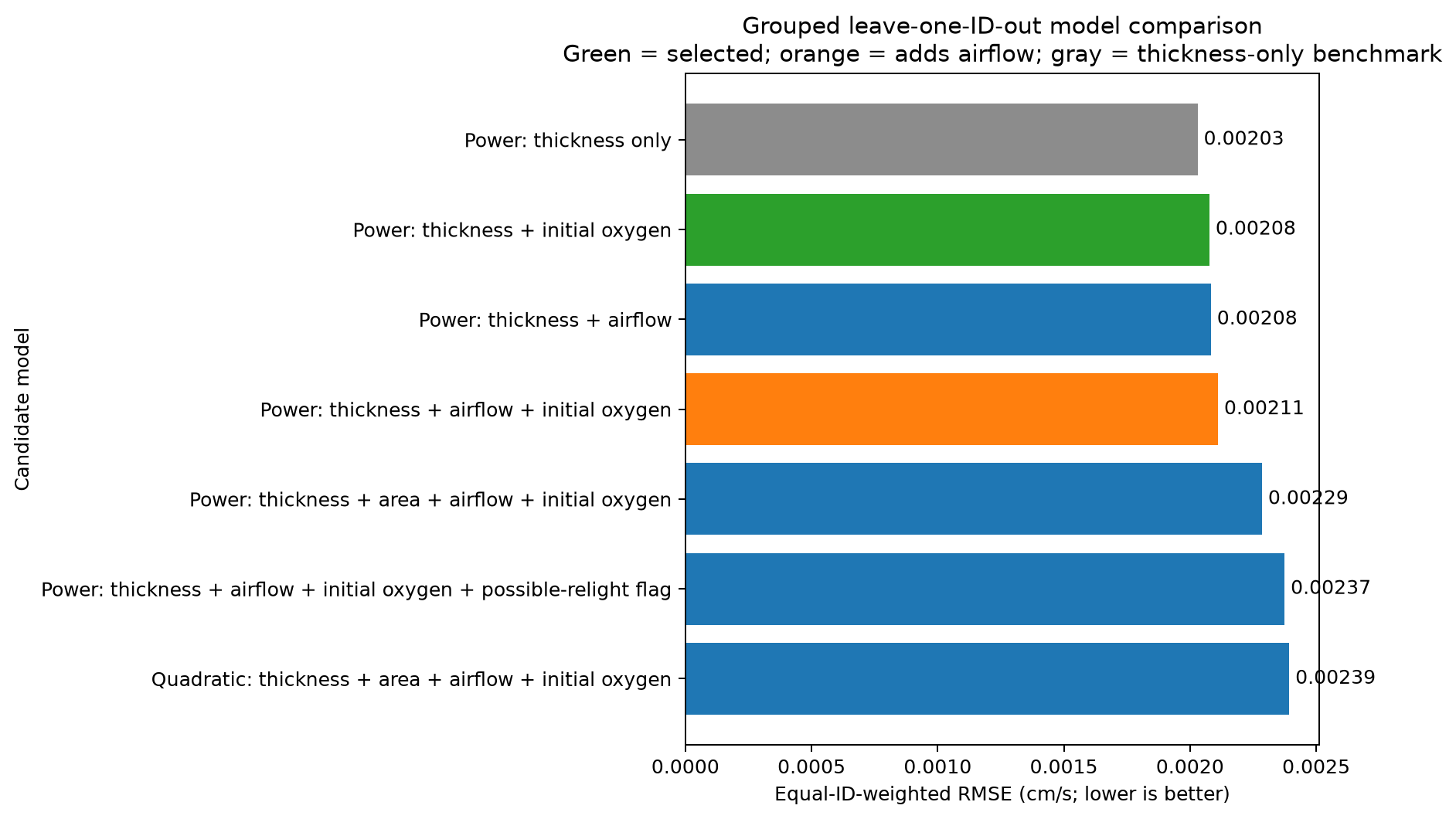
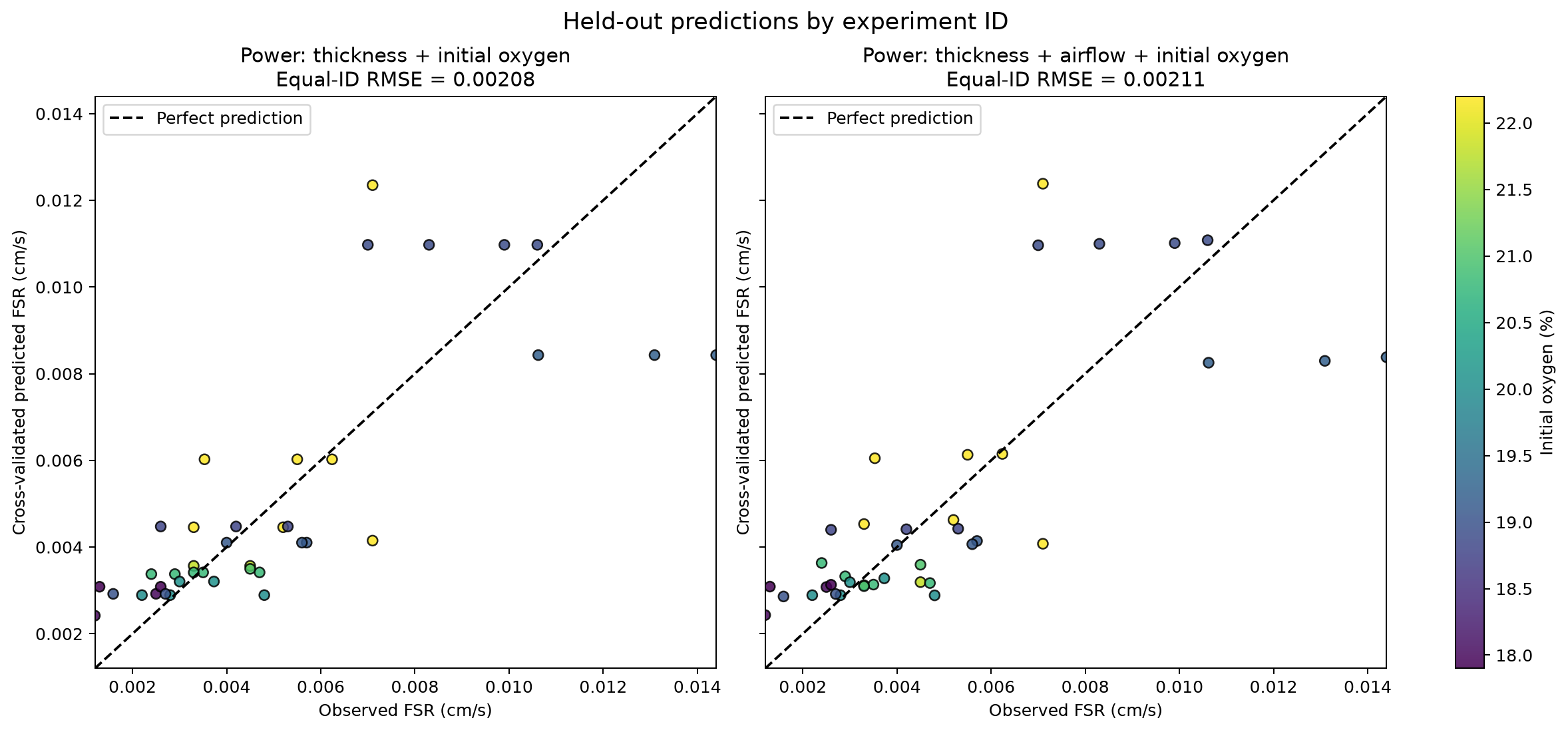
Several candidate regression models were trained and developed utilizing grouped leave-one-out cross validation, creating models to predict the mechanisms behind fire spread rate in our two data-set cases.
Results
Bass-II Fire Spread Model’s final predictive equation was:
FSR=−0.004640+0.0001282⋅(thickness)(−1.7904)+0.0000202⋅(airflow)+0.0003471⋅(oxygen)
Where:
- FSR = Fire Spread Rate (cm/s)
- Thickness = PMMA thickness (cm)
- Airflow = velocity (cm/s)
- Oxygen = Oxygen Concentration (%)
| Model | RMSE |
|---|---|
| Thickness Only | 0.00203 |
| Thickness + Oxygen | 0.00208 |
| Thickness + Airflow | 0.00208 |
| Thickness + Airflow + Oxygen | 0.00211 |
SAFFIRE-V’s model was:
FSR=0.05428+0.00138*(airflow)−0.17353*(rib)+0.12117*(rib)2
Where:
- FSR = Fire Spread Rate (cm/s)
- airflow = airflow velocity (cm/s)
- rib = rib width (cm)
| Metric | Value |
|---|---|
| Validation RMSE | 0.01307 cm/s |
| Feature | BASS-II | SAFFIRE-V |
|---|---|---|
| Observations | 39 | 18 |
| Scale | Laboratory | Spacecraft-relevant |
| Thickness Variation | Yes | No |
| Oxygen Variation | Yes | No |
| Airflow Variation | Yes | Yes |
| Geometry Effects | Limited | Significant |
| Peak FSR | ~0.014 cm/s | ~0.088 cm/s |
Impact and Contributions
AstroFlame contributes to aerospace fire-safety in three-ways:
Educational Accessibility
- Complex datasets become accessible to undergraduate student engineers and researchers, through a friendly web-based interface
Data Interpretation
- The platform provides context for understanding the difference between different experiments and scales for microgravity-flame experiments
Predictive Exploration
- Users can investigate how the environmental factors such as oxygen content and material thickness can affect flame spread, without complex manual processing of NASA data.
Limitations and Flaws
- This predictive model is derived from PMMA combustion experiments
- Predictions are only valid within observed experimental ranges
- SAFFIRE and BASS represent different physical scales and test configurations
- Limited experimental volume restrict generalization beyond tested conditions
Accordingly, AstroFlame should be viewed as an educational and exploratory research platform, rather than a certified engineering tool.